
Consider The Source
Trophy hunting advocates and Alberta MLA push for removing grizzly hunting ban after recent attacks

So let me see if I have this right. . . The grizzly bear population has exploded to such a degree since hunting was banned, that it is the only reasonable explanation for the recent spate of grizzly bear conflicts with humans. This is a ridiculous assertion and lacks supporting data and evidence, yet that is exactly what Todd Loewen, Minister of Forestry and Parks in Alberta, Wild Origins Canada, the British Columbia Wildlife Federation (BCWF) and other trophy-hunting organizations would have you believe.
As a wildlife conservation writer, my job is to persuade. I do this by presenting an argument and providing evidence to back it up. I also strive to bring balance to the stories I write by including both sides of the argument. That being said, I am aware of my own biases when I am writing and the importance of keeping them in check. Full disclosure - I am not opposed to hunting, but I am firmly against trophy hunting and commercial fur trapping and have been transparent about that in my articles. What I don’t do is intentionally mislead or make unsubstantiated claims to further my arguments. The stories I write are not true journalism in the sense that I remain an unbiased and impartial narrator; instead, I draw from my passion about wildlife conservation to present factual arguments with the goal of ending these cruel practices.
So, when it comes to making sense out of these renewed calls for a grizzly-bear hunt, it is critical to consider the source(s). Every single post, podcast, interview, etc. I have seen in favour of opening up a grizzly hunt is coming from hunting organizations and supporters with a grand total of zero coming from non-hunting wildlife conservation organizations. Do these calls to legalize grizzly hunting stem from a genuine concern for public safety, or is it more likely a self-serving effort to diversify the predator species available for trophy hunting? There is big money to be made by guide/outfitters who can offer grizzly-bear hunting to their rich clientele making their argument for opening up a hunt for grizzlies, tenuous to say the least.
Grizzly bear attacks are rare, but when they do occur, they are brutal and sometimes fatal. A recent attack that took place near Fort Steele, British Columbia (BC) on Elk hunter, Joe Pendry, resulted in horrific injuries to his face and skull and what began as a story of survival and resilience, suddenly turned to tragedy weeks later as he died from a blood clot. More recently in Bella Coola, BC, a teacher and three students were severely injured by a mother grizzly bear with two cubs while on a class field trip. The trophy-hunting community is deliberately exploiting these tragic events and other human/bear conflicts to persuade the BC and Alberta governments to consider re-opening grizzly hunting.
Ever the opportunists, they are attempting to capitalize on people’s fear in an effort to garner support for lifting the ban on hunting grizzlies. Alberta MLA, Todd Loewen, is signalling through online posts and statements, that removing the ban is an option he is considering. Bearing in mind that Minister Loewen is a former guide/outfitter himself, it’s not surprising that he appears eager to find a reason for lifting the ban to appease his trophy-hunting colleagues.
In a November 3, 2025 CBC online news report, Loewen stated that “all options are on the table” when asked about lifting the hunting ban. Without citing any evidence or supporting data, Loewen alludes to Albertans being at increased risk. “I think as a responsible government looking at the safety of Albertans, that we have to act and we have to take all things under consideration,” he explained to Kathleen Petty, host of Alberta at Noon. Yet, in a statement that seemed almost dismissive regarding the lack of recent studies regarding grizzly-bear population density, Loewen stated, “There’ll be studies done and everything, but I think it would be incredibly irresponsible for us as government concerned about the safety of Albertans just to put our heads in the sand and not look at the evidence that’s before us.” The evidence he is referring to is the recent grizzly conflict that injured a hunter in Cochrane, Alberta. He cites no evidence that speaks to whether there is an increase in grizzly bear numbers leading to more human/grizzly conflicts. It’s as if conducting scientific studies on grizzly populations should be treated as an afterthought making Loewen’s plan quite literally a shoot-first-ask-questions-later strategy.
What cannot be ignored is the blatant conflict of interest that has continually influenced Minister Loewen’s policies with regard to wildlife conservation in Alberta. Sure, he gave up ownership of Red Willow Outfitters to give the appearance that he had divested, but ownership remained in his family with his wife and son becoming co-owners of the trophy-hunting business. It is heartening to know that renewed calls for an ethics investigation were recently launched by The Alberta Wilderness Association and Exposed Wildlife Conservancy arguing, “. . . the minister has a clear conflict of interest in his duty, and his decisions in this role have prioritized his personal interests over those of Albertans.”
One only need look at the numerous decisions Minister Loewen has made during his tenure as Minister of Forestry and Parks to understand that he has prioritized the interests of the hunting and trapping communities to the detriment of wildlife in Alberta. Whether it is cougars, wolves, coyotes, wolverines, black blacks, etc., predators in Alberta are being persecuted for simply being predators. And now he has his sights set on grizzlies with the trophy-hunting community drooling in anticipation of a potential re-opening of the hunt.
And right on cue, Wild Origins, mentioned at the beginning of this article, is also exploiting these recent conflicts to make the case for re-opening the grizzly hunt in BC. As is the case with many of their articles, Wild Origins refers to ambiguous statistics and studies that really don’t support their position.
One of the claims made in a recent Wild Origins article entitled, Are Bear Attacks on the Increase in Canada? A Project Grizzly Balance Special Report, suggests that ongoing research into grizzly populations ceased with the grizzly hunting ban. “Banning grizzly bear hunting has resulted in a significant reduction, and in some cases complete elimination, of government-led research on grizzly populations in some regions.” You may have noticed that he specified “government-led research” as if the only credible research on grizzly bears comes from government-funded sources. Quite often, the opposite is true as independent research, not beholden to a funding source with political leanings one way or another, can deliver unbiased results that will stand up to scrutiny. I’m not so sure that biologists on government payrolls can always say the same. That said, the most recent population data available regarding the grizzly population in BC is from back in 2018 making any claims suggesting the population has increased or decreased, just speculative.
In the same article, Wild Origins concedes that human fatalities from grizzly conflicts have largely remained consistent over the years (two fatalities since 2012), but then suggests that human/grizzly conflicts are on the rise and could continue to increase in the coming years. Ok sure, but they could just as easily decrease and without credible evidence pointing one way or the other, it is irresponsible to make assumptions. They go on to toss in another speculative nugget to influence their readers indicating that bans on grizzly hunting in BC and Alberta may have led to more conflicts. “Grizzly bear hunting was banned in British Columbia in 2017 and Alberta in 2006. Some suggest that this has led to more grizzly attacks.” So who are they and what evidence did they provide to back up those claims? Again, it is misleading and irresponsible to make these assertions without providing evidence.
Wild origins concludes the article with the all-too familiar painting of BC’s urban population as being overly influential with regard to wildlife conservation policy and that rural voices are being ignored, writing:
In Western Canada, urban philanthropists and their foundations influence grizzly bear management discussions, often sidelining rural perspectives. Wild Origins Canada’s Project Grizzly Balance aims to reconnect science, community values, and management to restore the balance between rural people and grizzly bears.
When Wild origins elects to use the phrase ‘urban philanthropist,’ it is not a term of endearment; rather, it is a slight against what many in the hunting community label as naive and inexperienced people living in metropolitan areas who stand in opposition to trophy hunting. What is meant by “Project Grizzly Balance aims to reconnect science” is unclear, but if it means deferring to unbiased scientific studies to drive decision making, that would be a first. And the vague statement that ‘management restores balance’ neglects to describe what that balance is and by whose standard that balance is based upon. One thing for certain is the term “management” is code for killing grizzly bears as is “sustainable use.”
Wild Origin’s use of misleading statistics in their article seems intended to manipulate their readers into believing grizzly conflicts are on the rise. Looking closely into the data sources reveals that from 1990-2019, the data collected delineated between grizzly-bear attacks versus fatalities and concluded that the number of fatalities remained fairly consistent over this time frame. However, the data they included from 2024-2025 lumped both attacks and fatalities together skewing the total number attacks upwards making it appear as though they had doubled, a rather important distinction which they neglected to explain.
In a recent Facebook post, Gosia Bryja, PhD and compassionate conservationist, was quick to call out Wild Origin’s misleading use of statistics stating:
The central manipulation is this: the article claims that “the number of grizzly bear attacks surged to 11 in the 2020–2025 period, more than double that of any previous full decade.” But it is comparing five years to ten and presenting that as proof of doubling. Worse, the historical data from 1990–2019 record only fatal attacks, while those 11 “attacks” in 2020–2025 put fatal and non-fatal incidents together. This comparison is, thus, meaningless because the categories and time frames don’t match.
Wild Origins defended their use of combined statistics but, either wilfully or perhaps obliviously, neglected to address Bryja’s central argument that they combined both the non-fatal and fatal attacks together for part of the 2020-2025 period, thus, skewing the results.
Putting aside all the statistics and arguments, it is important to look into the motivation behind the Wild Origins article. The fact that they are a trophy-hunting organization should give one pause when it comes to accepting any notion that it was written out of a concern for public safety. This is an organization that is always promoting predator reduction in order for ungulate populations to flourish creating more trophy-hunting opportunities for big-game hunters. As Bryja noted, “On the surface, it sounds neutral and balanced, but the language and the use of statistics are shaped to promote a narrative decided long before the analysis even began.”
The BCWF is also piling on using these recent bear conflicts to make the case for re-opening the hunt for grizzlies in BC. Again, it is vital to consider the source when these claims are made. The BCWF is organization made up of hunters who are more than eager to add grizzly bears to the list of predators they can kill, not out of any altruistic notion of keeping people safe, but because grizzlies are coveted trophies in the the trophy-hunting world. The BCWF claims to be against trophy hunting, yet they promote the Boone & Crockett scoring system which ranks antler size based on “massiveness and symmetry” with “the most massive and symmetrical specimens scoring the highest.” The following quote is taken directly from the Boone & Crockett website: “We offer sportsmen a variety of products to use for green scoring their trophies.” The key word here is “trophies” which speaks to their motivation for wanting to re-open the grizzly hunt in BC.
In an effort to capitalize on the recent human/bear conflicts, the BCWF, in a November 21, 2025 post on their website entitled, Grizzly Conflicts are Bound to Keep Rising, wrote:
This week a group of school children and a teacher were attacked by a grizzly bear near Bella Coola, with 11 people suffering injuries. An elk hunter fought off a grizzly attack near Cranbrook on October 2 and later died from his injuries. A man hiking near Cochrane Alberta was mauled by a grizzly bear a few weeks ago and has survived his injuries. This is the new normal.
If this is the “new normal,” why then would Inspector Kevin Van Damme of BC Conservation Officer Service state, in an article originally published in the Canadian Press entitled, ‘Life and death’: Chief tells of trauma and bravery in grizzly attack on BC pupils, “This is extremely rare, and I think the public needs to understand that part. We are trying to determine the behaviour, and why the bear acted in the way it did.”
The BCWF goes on to report that since the 2017 hunting ban on grizzlies, calls to the Conservation Officer Service regarding human/grizzly conflicts have doubled to nearly 1000 annually in BC. But have they really? In a November 25, 2025 article by Larry Pynn published by Six Mountains, an online investigative publication based in the Cowichan Valley, entitled, Government stats refute organization’s claim re. public complaints related to grizzly bears, revealed that the BCWF is misrepresenting the statistics. Since the 2017 hunting ban, there have been only two years where calls approached 1000 - 965 in 2023 and 943 in 2019. In 2021, the number of calls annually was only 610 which was less than the total number in 2016 and 2017 prior to the hunting ban. The BCWF also neglected to point out that the nature and seriousness of the conflicts can range from mere sightings to actual attacks. As Pynn’s article details, “Conservation officers respond to only a fraction of reported calls. For example, in June this year the province received 130 calls regarding grizzlies, and responded to 20 of those.”
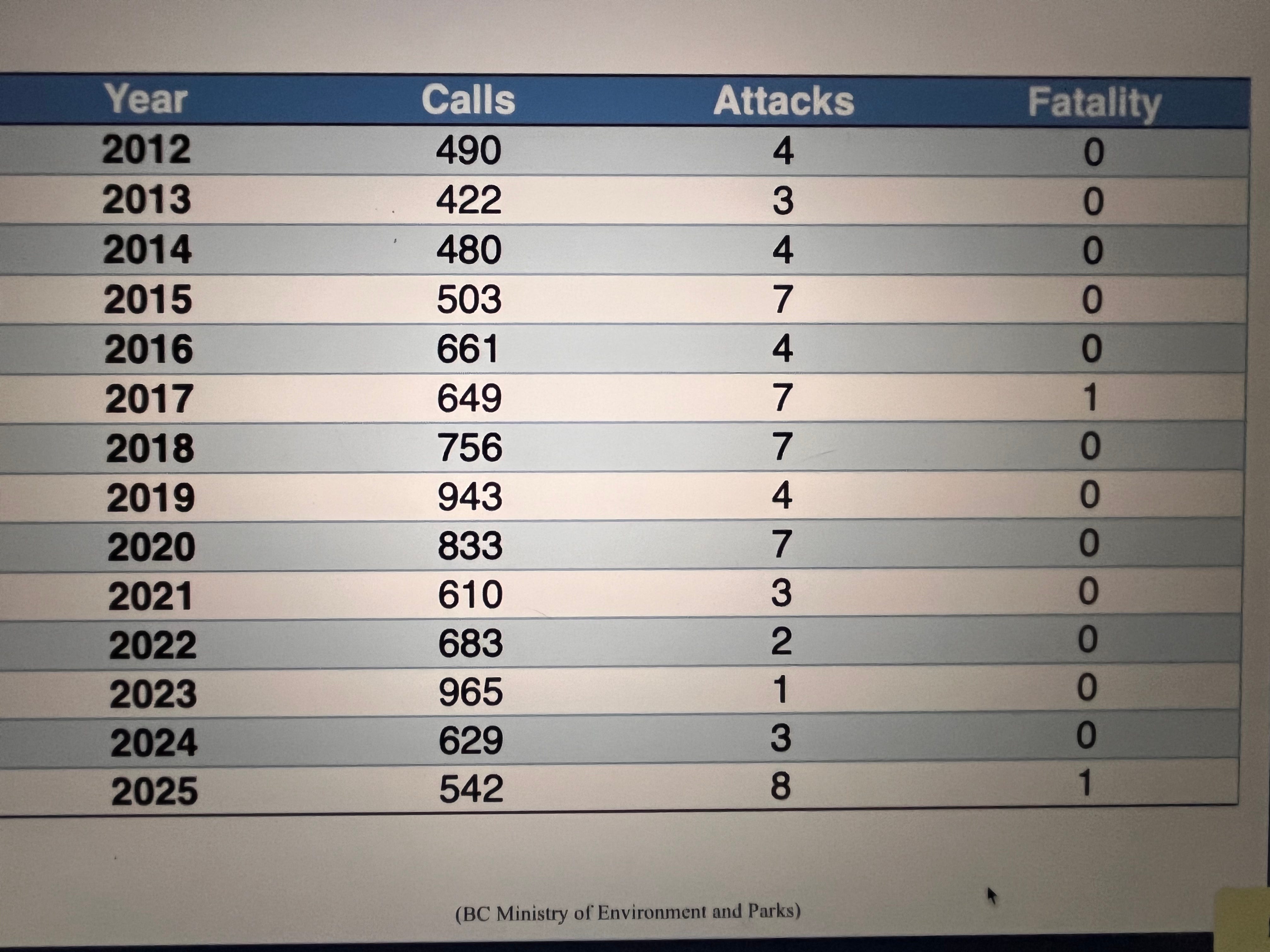
The BCWF also claims that, “when hunting pressure is removed, the number of problem grizzlies increases.” Yet they provide no evidence or statistics to back this up. And do they really expect us to believe that before the hunting ban was implemented, hunters were specifically targeting problem bears? That is an absurd notion. This willingness to misrepresent statistics and make unsubstantiated claims, as well as to use tragic events, speaks to the BCWF’s lack of credibility and questionable ethics when it comes to laying out the groundwork to remove the hunting ban on grizzlies in BC.
This question of ethics should not be overlooked when an Alberta MLA and groups including Wild Origins Canada and the BCWF eagerly exploit tragic events to further their hunting agendas and willfully ignore evidence and statistics. In the same Canadian Press article mentioned earlier, Nicholas Scapillati, Executive Director of the Grizzly Bear Foundation, expressed concern about pro-hunting organizations posting misinformation about bear aggression stating, “That’s so inappropriate at a time when we’re focused on holding the children and families and all those affected in our hearts and focused on them.”
It’s worth noting that it is most often hunters that are involved in conflicts with grizzly bears. Part of the reason for this is that hunters do everything contrary to the recommendations for remaining safe in bear country. People are advised to travel in groups and make lots of noise. Hunters often hunt alone and remain silent increasing their chances of a close-up bear encounter. Hunters often mimic elk bugling or moose calls to draw in their quarry, which can inadvertently capture a bear’s attention. They are also at increased risk when they are packing out their kills as grizzlies have a keen sense of smell. And whether it’s a false sense of security from carrying a rifle, many hunters choose not to carry bear spray repellent, which is a deterrent that has proven to be more effective at thwarting bear attacks than trying to accurately aim a rifle at a fast-charging bear. Granted, hunters probably spend more time in the wilderness during hunting season than non-hunters, but wildlife photographers, hikers and outdoor enthusiasts also spend much of their time in the wilderness and have fewer bear conflicts.
In a CBC article published October 30, 2025 entitled, Hunter mauled by grizzly bear west of Calgary, Kim Titchener, founder of Bear Safety & More, addressed the increased prevalence of hunter/grizzly conflicts. “Every hunting season, either here in Canada or the U.S., we have multiple cases of people getting mauled while hunting,” and added, “hunters move through the wilderness incredibly quietly, which may be one factor behind surprise bear encounters.” Titchener is advocating for hunters and all others who spend time in bear country to modify their behaviours stressing, “We need to change our behaviours and try to do the best we can to make it as safe as possible when we’re out either hunting or biking or trail running or going camping with our friends and family.” The reality though is that hunters have to remain stealthy if they are to be successful when hunting, but that can also result in them becoming the hunted. It is not without irony that hunters, due to the very nature of their activities, drive the human/grizzly conflict numbers higher, which the hunting organizations then use to make the case for re-opening grizzly-bear hunting.
If hunting organizations and associations were truly concerned about the safety of the public, then why are they focused solely on hunting as a means of reducing conflicts rather than endorsing the many non-lethal strategies that have proven effective at reducing human/grizzly conflicts? And why do they insist that co-existence with grizzlies cannot succeed without hunting? Well, as the title of this article suggests - consider the source. It has been well established that since Loewen became the Minister of Forestry and Parks, he has been in a conflict of interest, but when it comes to making a case for re-opening grizzly hunting, is that not also true of Wild Origins Canada, and the BCWF?
To learn more about the mindset of trophy hunters, check out my Substack article entitled, Trophy Hunting, The Dark Triad & Toxic Masculinity